
Marble mosaics - from ancient palaces to contemporary interiors
Step into almost any corner of the Roman world, and you would likely encounter a mosaic. Though the art form was already thousands of years old, the Romans made it ubiquitous across the empire using it to decorate floors and walls in private villas, public baths, civic buildings and religious spaces. Due to their incredible construction many examples survive today in Italy, North Africa, southern France, Turkey, Syria and here in the UK.
Roman marble mosaics ranged from restrained black-and-white geometric floors to elaborate scenes of gods, animals, hunting, theatre, food, myth and daily life. Their appeal was both aesthetic and practical.
Marble and stone are hard-wearing underfoot, while the small scale of tesserae allows curves, borders, shadows and pictorial detail that large slabs cannot achieve.


Mosaic examples unearthed from Pompeii, including an extract from the Alexander mosaic found at the House of Faun
The Ancient Art of Tesserae Production
Stone such as marble or limestone was cut into long, narrow strips using iron chisels and hammers.
The strips were then cut into small cubes using (what is now called) a hammer and hardie - a steel chisel fixed upright in a wooden block or stone base. The craftsman held the stone against the blade and struck it with a hammer, snapping off the tessera one at a time.
This method produced consistent tesserae, typically 5–20 mm across, with smaller pieces used for finer details.
At Lapicida, our own marble mosaics tiles are made in the same traditional way but are now conveniently backed onto mesh for ease of installation (see more later).

The Medieval Splendour of Mosaic
In medieval Italy, marble mosaic flourished in church floors, screens, pulpits and furnishings often through the work, passed down through generations, of the famous Cosmati family. This 12th and 13th century Roman technique used tiny triangles and squares of coloured stone including red porphyry, green serpentine, white and coloured marbles, combined with glass paste, stone discs and strips to form intricate geometric designs.
The Cosmati Pavement at Westminster Abbey was laid in 1268 by craftsmen from Rome. It is comprised almost entirely of stone recycled from ancient Roman monuments, including purple porphyry beloved by emperors.
Mosaics in the modern world - from sacred craft to decorative luxury
In the 19th and early 20th centuries, mosaic enjoyed revival through Victorian and Edwardian tiled interiors, Arts and Crafts decoration and Art Nouveau architecture. Many Victorian hallway floors used ceramic rather than marble, but they kept the domestic language of small-scale geometric flooring alive in patterned entrances, borders, thresholds and “rug-like” floors became part of the design vocabulary of the home.
There is also rich heritage of shop threshold signage which you can still see in place in older buildings today.
Today, marble mosaics survive in two parallel worlds - bespoke, hand-cut for unique spaces and luxury interiors, and machine-made mosaics for more a budget-friendly option.

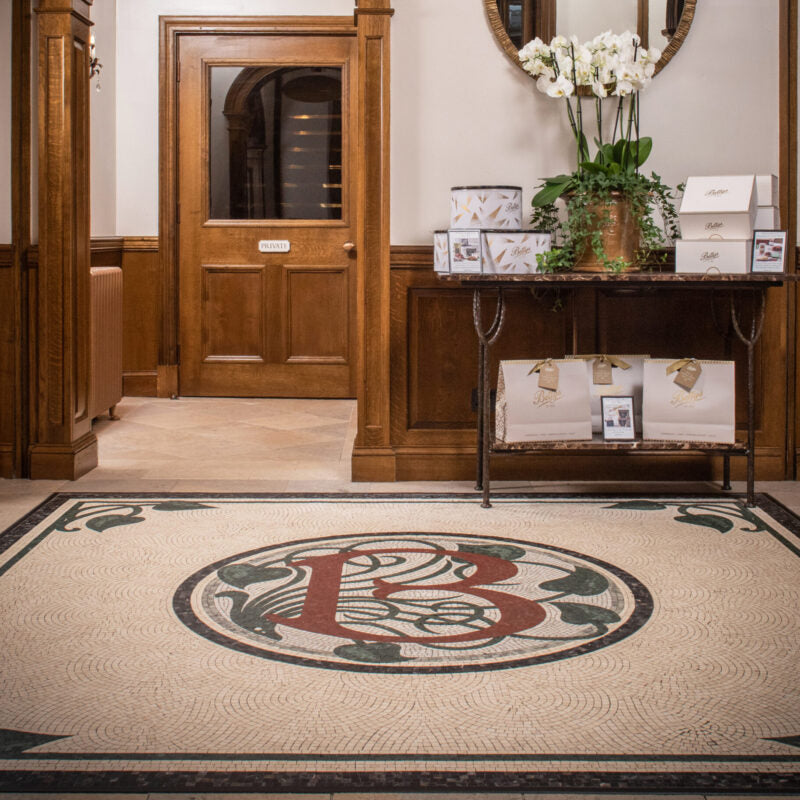

Examples of the 19th and early 20thC tradition of shop threshold signage, along with a modern example crafted by Lapicida in the entrance at Betty’s Harrogate
Why marble mosaics have endured
Marble mosaics remain desirable for a number of reasons.
They have human scale. Small tesserae soften the scale of stone. In the wrong place, a marble slab can feel overwhelming while a marble mosaic feels crafted, tactile and organic.
They offer pattern without print. The pattern is not applied to the surface; it is the surface. Veining, colour variation and grout lines create depth that printed materials rarely match.
Mosaics can be seen as architectural jewellery. Used carefully, marble mosaic can do what a border, rug, artwork or piece of hardware does - frame, define, punctuate and elevate a space.
Finally, they span both classicism and modernity. The same material can be used as a Roman-style border, a black-and-white checkerboard, a soft Carrara herringbone, a graphic fan motif, a geometric Art Deco floor, a minimal tone-on-tone shower mosaic and so much more

Our marble mosaics – crafted in Italy using the same ancient traditions
Our marble mosaics, available in 30x30cm sheets spanning 12 x12 tesserae come in a range of 10 colours. They come backed onto mesh which can be cut with scissors to support ease of installation. The sheets look sensational when used on their own, but the backing makes it easy to apply in an infinite range of patterns, just as ancient times.
Made using the same hand-crafting techniques as in ancient times, these tiles have gently tumbled edges, making each tiny tesserae unique, something you can’t replicate with the mass-produced alternative.

To complement the range, we also have 10x10cm marble inserts, giving even more options to create something special, while
helping to play with the rhythm of the space.
Marble Mosaic Installation and Maintenance
Luxury marble mosaics can create a stunning, timeless finish when installed and cared for correctly. For best results the team at tiling supplies specialists Pure Adhesion recommend using a high-quality white flexible tile adhesive that is suitable for natural stone. White adhesive helps prevent discolouration and ensures the true beauty of the marble shines through. For darker shades of marble, a grey adhesive is recommended.
Before grouting, it's it is best to apply a natural stone impregnating sealer. This helps protect the marble from grout staining and makes excess grout easier to remove during installation. Once the grout has fully cured, apply a second coat of sealer to protect both the marble and grout from everyday moisture and staining.
To keep your marble mosaics looking their best, clean them regularly using a pH-neutral stone cleaner. Avoid acidic or harsh cleaning products, as these can damage the stone and dull its natural finish.
With the correct installation and simple ongoing care, your luxury marble mosaic tiles will retain their elegance and beauty for many years to come.
In Conclusion: Why Marble Mosaics Still Matter
Marble mosaic has endured not because it follows trends, but because it offers something few materials can - a combination of natural beauty, craftsmanship and lasting character.
Across centuries, the setting may have changed - from ancient temples and Renaissance villas to Victorian townhouses and now contemporary interiors - but its appeal has remained remarkably consistent. It has always been treasured for its ability to elevate everyday surfaces through detail and the unique qualities of natural stone.
Today, hand cut marble mosaics feels as relevant as ever. Their versatility allows it to sit comfortably within both traditional and contemporary architecture, while its inherent durability ensures it is as practical as it is beautiful.
The balance of authenticity and timeless design is what continues to make marble mosaics one of the most loved materials in interior architecture.